Before the Community Mural: A Short History of Making Art in Public
A short history of public art traces shared making from medieval guild projects to Victorian parks and modern murals, with context for local work.
How did public art become something a neighbourhood could make together, rather than simply look at? A short history of public art is not a straight march towards the community mural: it is a series of changing arrangements between makers, patrons and audiences. Medieval church building, Renaissance civic commissions, Victorian parks and twentieth-century mural projects each offer a distinct account of who could shape a shared place.
Public art began with shared places, not a single tradition
“Public art” is a modern umbrella, and it can obscure how different earlier works were in purpose and ownership. A church fresco, a civic statue and a street performance might all be encountered by many people, but they were made under different systems of belief, authority and labour. It is more accurate to follow particular settings than to treat them as one continuous tradition.
In medieval Europe, churches commissioned painted walls, sculpture and stained glass as parts of religious buildings. These works were generally commissioned and directed by religious institutions, with skilled makers carrying out the work; they were not community projects in the contemporary sense. Their placement in spaces used by congregations made them part of shared experience, but not evidence that every viewer had a say in their design.
This distinction is useful now. A work can be public in its setting and still be controlled by a patron or institution. Asking who paid, who made decisions and who could enter the space gives a more grounded account than describing an artwork simply as “for everyone”.
Renaissance civic commissions made public authority visible
During the Renaissance, Italian city-states used civic buildings, squares and monuments to express political identity as well as religious devotion. Florence’s Palazzo Vecchio, for example, housed the city’s governing institutions and accumulated art and decoration connected to civic power. The building’s art belonged to an official setting; it should not be mistaken for shared authorship by the city’s residents.
Such commissions help explain why public art has often carried competing meanings. A monument might offer a city a common emblem while also presenting the viewpoint of its rulers. The audience could be broad, but the decisions about subject and placement remained concentrated among patrons and authorities.
There is no need to force a modern participation story onto these works. Their historical value lies partly in showing that public visibility and public control are different things.
Victorian parks widened access without sharing every decision
In nineteenth-century Britain, parks and museums became prominent parts of civic life. The opening of public parks, including Birkenhead Park in 1847, reflected arguments about recreation, health and access to green space. Designed landscapes, gates, fountains and monuments shaped how visitors experienced those places, though public access did not mean that visitors had commissioned or co-designed them.
As towns expanded, civic decoration could express local identity through statues, memorials and buildings. These works created shared reference points, but their subjects often reflected the priorities of institutions and donors. Looking at them today means attending both to what they commemorate and to whose histories are absent.
What is not worth the effort is calling every artwork in a public park collaborative simply because people can visit it. The more helpful question is whether people influenced its creation, not whether they later encountered it.
Community murals brought participation into the making process
In the twentieth century, community mural projects made collaboration a more explicit part of public art. The movement developed in varied local conditions rather than from one origin. In the United States, the Chicago-based Wall of Respect, painted in 1967 by members of the Organization of Black American Culture, honoured Black cultural figures and became an influential example of community-oriented mural making. Its history is specific: it arose from a particular group and political moment, not from a universal model for every neighbourhood.
Later projects in different countries and cities used workshops, local research and shared design discussions to involve residents in decisions. The amount of influence varied. Participants might propose subjects or images, while an artist retained responsibility for composition, materials and painting. Describing those roles precisely is more informative than applying the label “community-made” without explanation.
A mural can therefore mark a change in process without ending the older question of authority. Who chose the wall? Who approved the design? Which contributions changed the finished work? The answers show whether collaboration shaped the artwork or remained a consultation around decisions already made.
Shared authorship changes what a mural can record
When residents help decide what appears on a wall, the work can reflect local references that an outside designer might not know. A corner shop, a route to the library or a phrase used at a community hall may carry meaning because of how people use a place. The result can register relationships as well as visible landmarks.
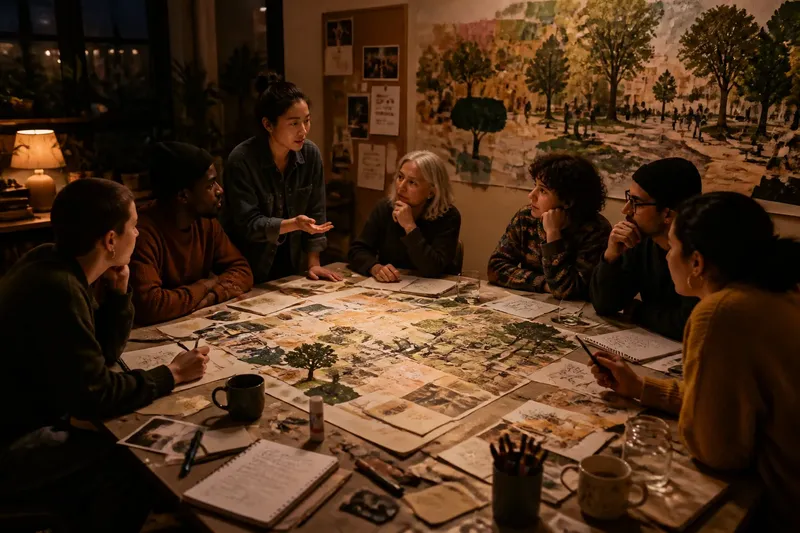
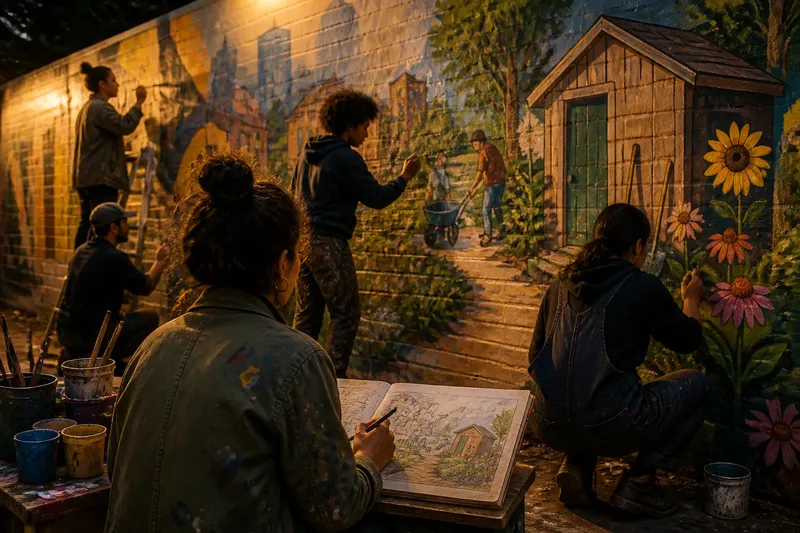
Say a fictional residents’ group is planning a mural beside its community garden. Its starting proposal shows flowers; during a meeting, participants ask to include the shared tool shed and the path they use to carry compost. The designer revises the composition to include both details. The observable result is an image that refers not only to the garden’s appearance but also to its shared work, while the designer still makes the final decisions about how those elements fit together.
That distinction matters: participation need not mean that everyone has equal control over every choice. A clear account can credit the group for selecting the subject and details, and the artist for translating them into a composition. It can also name limits, such as a decision about the wall’s location made by the building owner.
How does public art history help with a mural today?
Is a community mural the oldest form of public art?
No. The phrase “community mural” describes a modern approach to making, while public images and decorated shared spaces have much older, varied histories. Earlier works should not be treated as collaborative in the contemporary sense unless the evidence supports that description.
Does public art have to be permanent?
No. A temporary installation or performance can be public art when it is made for a shared setting and encountered as part of public life. Its temporary character does not by itself tell us whether it was collectively authored.
What makes a mural collaborative?
Look for decisions participants actually influenced, such as subject, imagery, location or making methods. Being consulted or depicted in the final work does not, on its own, show that participants shared authorship.
How can a project record its history?
A short project note can name the people or groups involved, describe which decisions they shaped and explain who held final approval. A local library, archive or community organisation can keep the record where future residents can find it.
A historical account should distinguish access from authorship
From medieval church commissions to civic monuments and community murals, public art has taken shape through different relationships between institutions, artists and audiences. The sequence is not a story of inevitable progress: a later project may involve residents closely, while an earlier work may have been visible to many but directed by a narrow group.
For a new mural, the history of public art offers a useful question: which decisions will be shared, and which belong to the artist, funder or site owner? Recording the answer gives the work a more honest public history, and helps future viewers understand not just what they see but how it came to be there.