The Myth of the One-Voice Group Project
A one-voice group project need not erase disagreement. Learn how shared decisions, credit and consent can make collective authorship clear without flattening difference.

Who gets to speak for a group artwork when its makers disagree? A one-voice group project need not mean that every participant shares one style or opinion. The more useful question is how the group makes its decisions visible, so collective authorship does not quietly become one person’s control.
That question concerns process as much as appearance. A group might share the subject, the public message, the method of making, or the responsibility for explaining the finished work. It need not share all of them. Naming what belongs to the group—and what remains each maker’s own—helps prevent a polished result from concealing an uneven agreement.
Shared authorship depends on who makes the decisions
People often call a work collaborative because several people contributed materials or labour. But contribution alone does not tell us who chose the subject, edited the work, approved its display or wrote its accompanying text. Those decisions shape how the group is represented, and they deserve attention before the work is presented publicly.
A useful starting point is to separate decisions by their reach. A maker can decide what to put into their own contribution; the group can decide how the project is described and where it is shown; a smaller organising team can handle practical tasks that the group has agreed to delegate. The important part is making those boundaries understandable and revisable.
This does not require a meeting about every small choice. It does require a route for raising a concern when a practical decision changes the project’s meaning, or when someone’s contribution is being altered beyond what they agreed to.
Agree on the project’s claim before making it
A shared project often carries an implied claim: that participants support a message, represent a place, or speak as a community. That claim can be more consequential than the materials on the table. Before making, discuss what the work is meant to say and who is entitled to say it on the group’s behalf.
For a public-facing project, distinguish a shared position from a collection of personal responses. If participants do not agree on a single message, the group can present the work as a conversation or set of perspectives rather than force a statement that some makers would not endorse. A short description should reflect the agreement that actually exists.
It is also reasonable to leave some things unresolved. The group can say that participants approached a subject differently, rather than turning difference into a false consensus. Plain language is more credible than a grand statement that nobody remembers approving.
Credit should match the work people chose to do
Credit is not a decorative afterthought. A public label, programme note or online post can name individual makers, the group, facilitators, or some combination, depending on what participants want and what the work involved. Ask people how they wish to be identified; do not assume that everyone wants a name attached to a public project.
Credit can also clarify roles without creating a hierarchy of artistic worth. Someone who organised a room, translated a discussion or helped prepare materials may want recognition for that work, while another participant may prefer to be named only as a maker. A concise record of agreed roles can help the group produce accurate captions later.
Where a contribution is anonymous or collective, check that the description does not identify its maker indirectly. In a small neighbourhood group, a detail about a person’s role or circumstances may be enough for others to work out who they are.
Use consent as an ongoing decision
Consent to take part is not automatically consent to every edit, photograph or future use. Participants should know what is being made, how it may be displayed, and whether images or names might be shared beyond the original venue. If plans change, ask again rather than treating an earlier yes as permission for everything that follows.
For changes to another person’s contribution, ask the maker first. For changes to the project’s public description or overall arrangement, use the decision method the group agreed to. A clear process makes it easier to distinguish a practical adjustment from a change in meaning.
If the project involves children, sensitive personal material, or formal permissions, follow the relevant organisation’s policies and seek qualified advice where needed. This is a general approach to respectful collaboration, not legal guidance.
What should a group decide before a public display?
How should disagreements be handled?
Agree whether the group will seek consensus, use a named facilitator to gather views, or make a decision by another process. If a decision affects an individual contribution, pause and ask its maker before proceeding.
Can a participant withdraw a contribution?
Discuss withdrawal before making, including what happens if removal would affect the rest of the project. The group should explain any practical limits plainly and avoid promising arrangements it cannot honour.
Who speaks to visitors and the press?
Ask who is willing to speak, and decide whether they are sharing a personal view or an agreed group position. If no common position exists, say so rather than presenting one participant’s interpretation as everyone’s.
What should the caption say?
Keep the caption faithful to what participants agreed: identify the project, describe its purpose without overstating consensus, and credit people in their preferred way. Check the wording with the group before it is printed or posted.
A worked decision can expose hidden assumptions
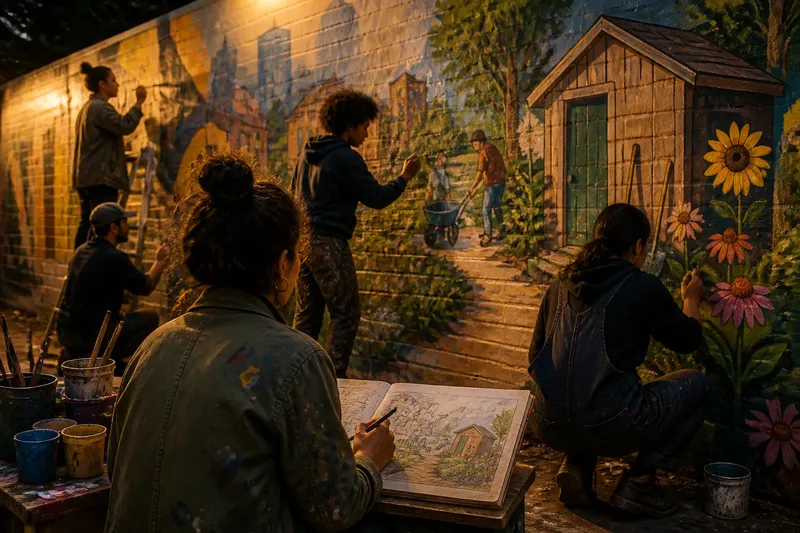
Say a fictional group at a neighbourhood library is preparing a wall piece about changes to a local park. Its members disagree about whether the work should celebrate renewal or draw attention to lost trees. They decide, in this invented situation, not to present a single verdict. First, they agree that the piece will show differing responses to the park. Then each maker chooses whether to contribute under their name, anonymously or as part of the group. The organising pair drafts a caption describing the work as a collection of perspectives, and the group reviews it before display. The resulting decision is clear: the makers share a project and a venue, but do not claim to share one opinion.
The useful lesson is not that every group should avoid a common statement. It is that a common statement should be chosen, not inferred from the fact that people worked together.
Keep the process clear without over-managing it
For a meeting or planning note, these checks connect an observation to a decision. If the answer points to a problem, choose the alternative action rather than hoping it will disappear.
- Observe whether the group can state the project’s purpose in similar plain language. If it can, use that wording in the brief; if it cannot, describe the work as multiple perspectives or revisit the purpose together.
- Observe whether makers know which decisions they control. If each person can name their choices, proceed; if not, clarify individual and shared decisions before editing contributions.
- Observe whether anyone’s work may be changed without their knowledge. If the answer is no, continue with the agreed process; if yes, pause the edit and ask the maker what may be altered.
- Observe whether participants have chosen how they want to be credited. If preferences are recorded, prepare the label accordingly; if not, ask privately and leave uncertain names out until confirmed.
- Observe whether the planned display or sharing differs from what people agreed to. If it matches, proceed with the plan; if not, explain the new use and seek fresh consent before proceeding.
- Observe whether one person is being treated as the group’s spokesperson by default. If a representative has been agreed, clarify the limits of that role; if not, invite volunteers or present the group’s agreed text without attributing it to a single voice.
It is not worth the effort to predict every disagreement or write a rule for every possible edit. A short, understood process is more useful than a dense document nobody can apply. The main search phrase, one-voice group project, points towards a question of authorship: what is genuinely shared, and what should remain open to individual choice?
Before the work leaves the making space, check that its caption, credits and permissions tell the same story as the process that produced it. That final conversation can be brief, but it gives participants a chance to recognise themselves in the public version of their work.