The Pass-Along Table: Why Shared Making Begins Before Anyone Starts
A pass-along table for shared making gives newcomers a low-pressure way to handle materials, follow an unfinished example and join a group project.
How can someone join a creative session without having to announce an idea or ask what to do? A pass-along table for shared making offers a quiet answer: set out materials and unfinished examples where people can look, touch, and begin at their own pace. The table is not a display of finished work. It is a visible invitation to make a small contribution.
That distinction matters in a library room, a neighbourhood hall, or the corner of a busy community studio. People may arrive at different times, know one another unevenly, or be unsure whether their ideas are welcome. A table that already holds a few possible beginnings can make the first move feel less like a performance.
A pass-along table makes the first move visible
In a conventional activity, a facilitator might explain the project and ask everyone to start together. That can suit a group that knows what it wants to make. But it places the first act of participation in speech: a person must listen, understand the plan, and then decide how to enter it.
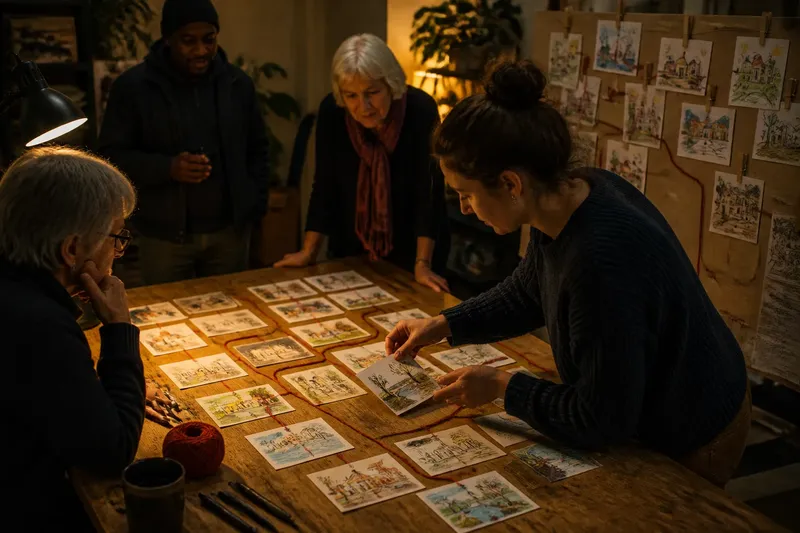
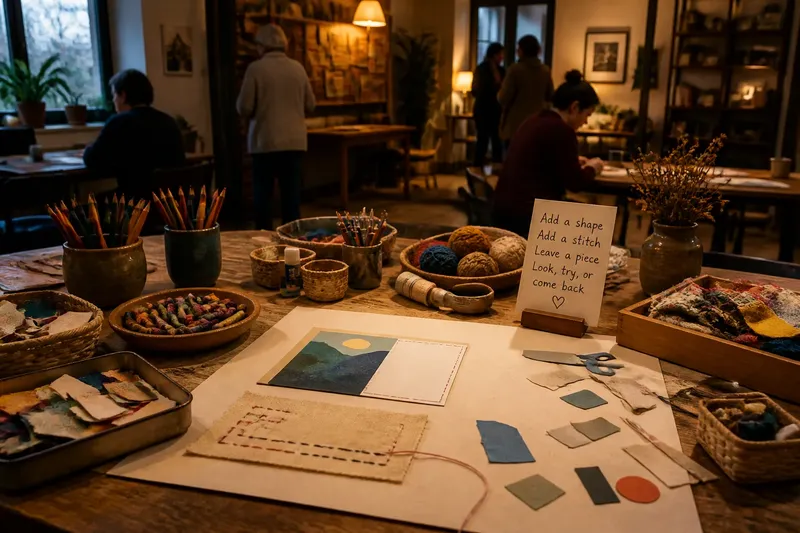
A pass-along table puts the invitation in the room instead. It might hold paper strips, coloured pencils, cloth offcuts, blunt-ended needles, and a partly decorated card. The unfinished card is neither a model to copy exactly nor a finished object to admire. It shows one possible action and leaves space for another.
The table works through small, legible choices. Someone can add a mark, sort a handful of materials, or simply examine the example before joining. None of these gestures needs to be announced as a commitment to the whole session.
Unfinished examples invite continuation, not imitation
An unfinished example is most useful when it demonstrates a way in without prescribing the result. A scrap of fabric with one loose row of stitching can show how thread behaves; a paper shape with a gap can suggest that another piece might fit nearby. The open area is part of the instruction, even if nobody explains it aloud.
Finished samples can still help people understand the materials, but they can also make an activity seem like a test of skill. If every sample is polished, a newcomer may assume that their contribution should match its level of finish. An example with a visible edge, pause, or empty space tells a different story: this is in progress, and someone else can carry it forward.
Keep the number of examples modest. A crowded spread of elaborate possibilities can turn an easy invitation into a choice problem. One or two contrasting beginnings are often enough to show that participants may continue an idea or take it somewhere else.
Materials should make joining feel manageable
Arrange materials so that their possible uses are easy to read. Put paper beside pencils, yarn beside fabric, or collage scraps beside glue sticks. Leave tools that require more explanation with a clear sample or an accessible alternative. The aim is not to remove all uncertainty; it is to keep a person from having to decode the entire table before doing anything.
Offer different kinds of participation. Some people prefer to draw, some to arrange, and others to handle a material before deciding. A shared surface can support all three. A small tray for scraps, a few sheets of backing paper, and a labelled place for work that is still underway can help contributions remain available to the group.
Labels should answer useful questions rather than dictate a result. “Paper for adding a shape” gives a clearer starting point than “be creative”. If an activity depends on a particular material’s label, the maker’s instructions, or local rules, follow those directions and choose a suitable alternative where needed.
How can a table welcome people without directing them?
What belongs on a pass-along table?
Choose materials that can be handled and combined without a long explanation, alongside one or two unfinished examples. A simple arrangement of card, pencils, and paper shapes can be enough to show both a starting action and room for a different one.
Should everyone contribute to the same object?
Not necessarily. The table can support a shared object, a set of related pieces, or contributions that remain separate until the group decides what to do with them. Make the invitation clear about whether pieces may be moved or joined together.
What if someone only wants to look?
Let looking count as an ordinary way to enter the room. A person may take time to understand the materials, watch how others use them, or return later without needing to explain the pause.
How can the table stay inviting as work accumulates?
Leave room for new contributions and make unfinished work easy to distinguish from spare materials. A shallow tray or a sheet of backing paper can keep pieces together without making them feel closed to further change.
A gentle invitation still needs a clear boundary
Open-endedness does not mean participants should have to guess what is shared. A small note can say which materials are for everyone, where an individual piece may be set aside, and whether it is all right to add to work already on the table. These are practical permissions, not rules for what the finished work must look like.
Imagine a neighbourhood studio setting out folded paper, wax crayons, and a card with one corner left blank. A visitor adds a blue shape to the card, then places several more shapes on the shared backing sheet rather than attaching them. The visible result is twofold: the card now has another hand in it, and the loose pieces give the next person an obvious choice about whether to arrange, add, or simply look.
That kind of beginning depends less on a clever prompt than on a table’s small signals: what can be touched, where a contribution can go, and how much freedom remains after someone joins. It is not worth spending effort on elaborate signage or a perfect display if the materials themselves already explain how to begin.
A pass-along table for shared making is most useful when it stays a working surface rather than becoming a stage. Keep one unfinished possibility visible, leave space for the next person’s hand, and let the arrangement change as the group does. The first contribution may be modest; it can still make the room feel like a place where others are expected to continue.