One Big Piece or Many Small Ones? Choosing a Format for Group Artwork
Choose a group artwork format that fits how people can take part, and make the finished work’s purpose clear to contributors and viewers alike.
How should you choose a group artwork format when people have different schedules, materials and ideas? For group artwork, the real choice is often whether to make one piece whose parts affect one another, or a collection that preserves distinct contributions. Start with what the work needs to communicate, not with a preferred look.
Let the project’s purpose set the structure
A group project might aim to show a place through its residents’ memories, invite passers-by to add marks, or gather independent responses to one prompt. Each aim points towards a different structure. A single surface makes interaction visible; separate pieces make individual voices easier to distinguish; a hybrid can keep both in view if the relationship between its parts is clear.
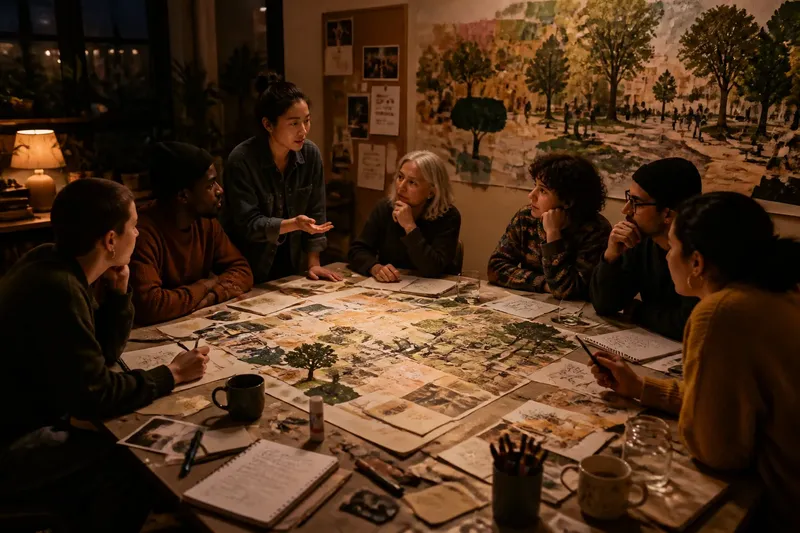
Before choosing materials, finish this sentence together: “A viewer should be able to see…” The answer might be a shared transformation, a range of personal responses, or a route linking several ideas. If the group cannot agree on that sentence, choosing paper, fabric or boards will not settle the deeper question.
It is not worth trying to make every contribution look alike merely to create unity. Consistency helps only when it serves the project’s purpose; a repeated colour or shape can connect varied work without making each person’s piece interchangeable.
Use a shared surface when interaction is part of the idea
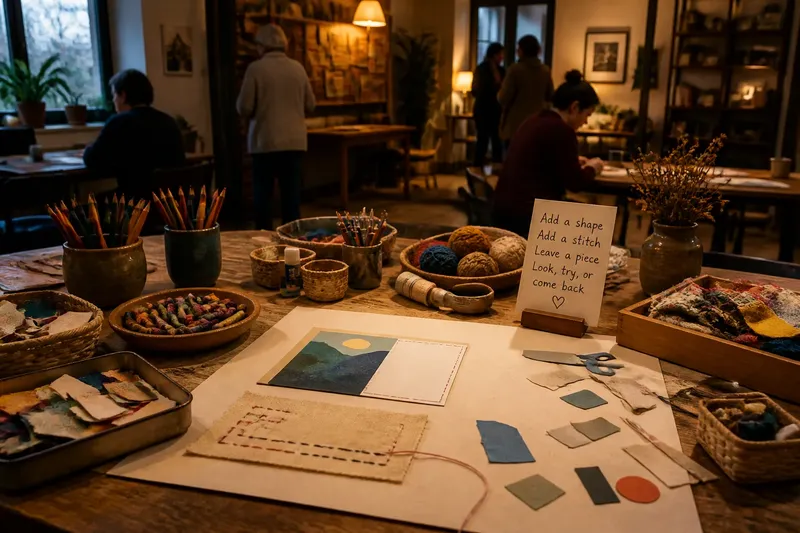
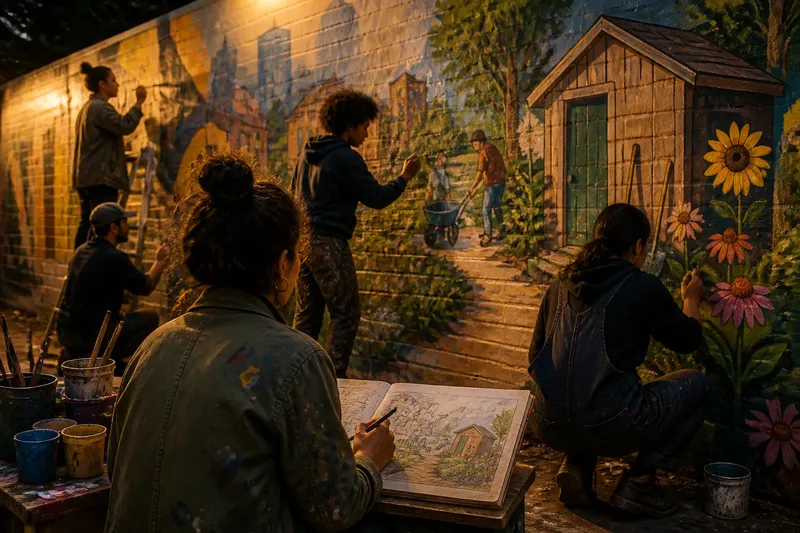
A shared surface suits a project in which contributors are meant to respond to what is already there. A roll of paper on a community-centre table, a fabric panel or connected boards can let people add, adapt and negotiate in view of one another. The surface becomes a record of collective choices, rather than simply a place to gather finished work.
This format needs a clear invitation and a modest way to handle disagreement. “Add something that belongs in this shared garden” leaves room for interpretation; a detailed image to fill in may leave little genuine choice. The facilitator can offer prompts and explain where materials are, but should not settle every uncertain decision on the group’s behalf.
A shared surface is less suitable when people need to contribute at different times or want their marks left untouched. In those circumstances, the group may spend more energy managing access and boundaries than making the work it intended.
Use separate pieces when contributors need distinct authorship
Individual cards, small panels or fabric squares can be made at different times and in different places. They also let contributors choose their own approach: one person might draw, another stitch, and another add a short written response. The structure is especially useful when the project wants to show differences rather than merge them.
Separate pieces need a reason to sit together. A shared question, repeated motif, sequence or deliberate contrast can make their relationship legible. Without such a link, the result may read as a collection of unrelated items—which can be a perfectly honest aim for a showcase, but is not the same as a unified composition.
Decide who will arrange the pieces and what authority that person has. If every contribution should remain intact, say so before making begins; then the arranger can work with spacing and order rather than cutting or altering someone’s work to solve a display problem.
Choose a hybrid only when its parts have different jobs
A hybrid can work when individual contributions have a shared purpose beyond simply accommodating every suggestion. Personal panels joined by a group-made border, for instance, preserve distinct images while making the frame itself a collective element. A series of separate pages bound into one book can likewise keep each response visible while creating a shared sequence.
Be specific about what is individual and what is collective. If contributors make their own panels but the group may add a border, explain whether that border can overlap the panels or must remain separate. A simple agreement prevents the word “collaborative” from concealing uncertainty about who gets to change what.
Check the conditions before committing to a format
Use the group’s actual circumstances to make the choice. For each observation below, follow the stated decision; where the situation points in different directions, decide which condition matters most to the project’s purpose.
- Check whether contributors can be present at the same time: If most can work together and live exchange matters, choose a shared surface; otherwise, use separate pieces that can be collected later.
- Check whether contributors want their marks altered: If people welcome responses and additions, a shared surface is viable; if they want their work kept intact, choose separate pieces or set clear boundaries on a shared surface.
- Check whether the prompt asks for one collective image or many perspectives: If the answer is one image shaped together, use a shared composition; if distinct viewpoints are the point, preserve them as separate contributions.
- Check whether the venue can display the proposed material: If the venue can mount and accommodate it, retain the planned format; if not, ask what it can support and adapt the material or structure before making starts.
- Check whether contributors need to work in different places: If they do, choose portable separate pieces; if they can use one supervised work area, a common surface remains an option.
- Check whether the group can name a clear link between separate pieces: If it can, use that prompt, sequence or motif to connect them; if it cannot, either make their independence an explicit part of the display or reconsider a shared composition.
- Check who will decide the final arrangement: If the group accepts a named arranger’s role, agree its limits; if it does not, set a shared arrangement process before anyone begins.
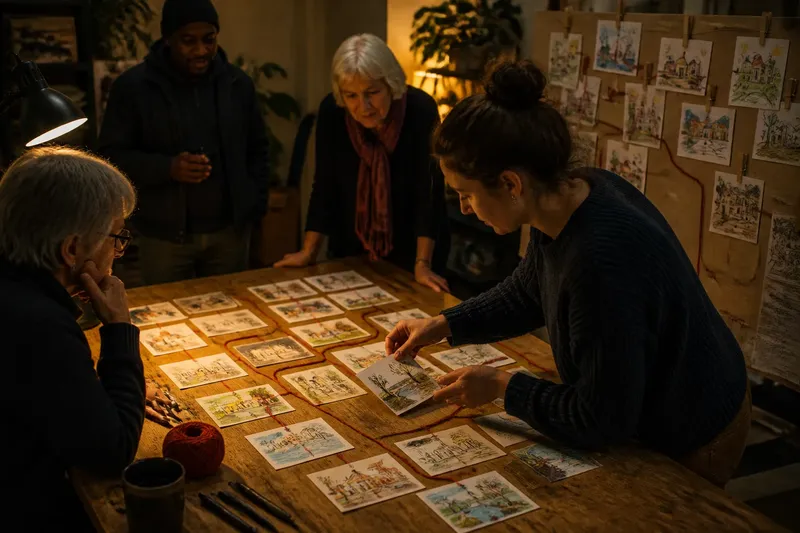
Say a neighbourhood group has an invented project about residents’ favourite local places. People can only attend at different times, and they want to draw on postcard-sized cards without having their images changed. The group chooses separate cards and agrees to arrange them as a walking route; each contributor marks a place and returns the card, then the organiser lays the cards in route order without editing them. The expected result is a display that preserves each drawing while showing how the places connect, though it will not capture the live exchange a shared surface might have offered.
Make display decisions part of the plan
A work made for a library foyer, shop window or community hall needs to suit that location. Ask the venue about its mounting options and any restrictions before choosing a material. Paper cards may need a backing; fabric may hang differently from a board; a set of pieces needs enough separation for viewers to distinguish them. If installation raises a safety concern, ask the venue or a suitable professional rather than improvising.
Consider how the work reads both from a distance and up close. A single composition may form a strong overall image while small marks disappear; individual pieces invite closer attention but need an arrangement that lets viewers see their differences. Choose the viewing experience that suits the project rather than asking one format to do everything.
What should a group decide about its artwork format?
Can one project include shared and individual work?
Yes, if each part has a distinct role, such as personal panels within a group-made frame. Agree in advance which elements contributors control and which the group may change.
How can separate contributions feel connected?
Give them a shared prompt, recurring motif, sequence or deliberate contrast. Keep enough freedom for each piece to retain its own character.
What format suits people who cannot attend together?
Separate pieces are usually easier to make asynchronously because contributors can work in different places and return their work later. Provide a clear prompt, a return method and an explanation of how the pieces will be presented.
Who should decide how the finished work is arranged?
The group can choose an arranger or agree to make the arrangement together. In either case, settle the arranger’s authority and the treatment of work that does not fit before making begins.
Choose the format that makes the invitation clear
For group artwork, the most useful format is the one that matches the project’s purpose and gives each participant a clear understanding of their choices. One shared surface makes interaction part of the work; separate contributions protect individual decisions; a hybrid can join those qualities when its boundaries are agreed.
Before the first mark, tell contributors what they can decide, whether anyone may alter their work, and how the finished piece will meet its audience. That small agreement does more than prevent confusion: it lets people choose how to take part with their eyes open.